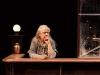
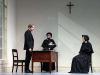
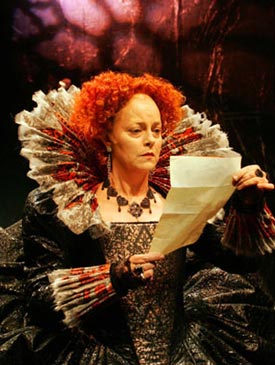
 Left - Greta Scacchi. Cover - Greta Scacchi and Patrick Dickson
Peter Oswald’s new version of Friedrich Schiller’s 1800 play Mary Stuart is one that will please both history buffs as well as those seeking a compelling character drama. This tale deals with conflicts over large matters of state on a primarily personal level, concerning figures for whom these weighty matters are as much tied up with ego and personal animosity as they are questions of political expediency.
Concerning intrigues occurring in the final days of the incarceration of Mary Queen of Scots by Queen Elizabeth I, her first cousin once-removed, the play is rooted in its historical milieu and is surprisingly light on exposition regarding the wider geopolitics and historical backstory, so it pays to be informed as to the general context (The movie Elizabeth will do reasonably well if you don’t fancy using Wikipedia). Nevertheless, the play is fairly static to begin with, and may take a few scenes for the burgeoning plotline to reel you in.
Largely dealing with Mary’s last-ditch efforts to either escape her captivity or meet with Elizabeth and petition her to avoid the executioner’s block, the narrative uses a nice balance between the stories of these two powerful, fascinating women and the closely-related schemes of those around them. In a time where we look to the baffling cults of personality and rhetoric that subsume much of the real politics in the current U.S. election, it is interesting to see a depiction of rulers who similarly inspire all manner of different, contradictory reactions from both the powerful and the lowly. Adoring, loathing, obsessive, conniving, zealous, cynical… all these come forth in the spectrum of responses from the people that surround these two queens and the conflicting assortment of things they want for (or from) them.
As you may have gathered, Mary Stuart has a much larger cast than is typical at the Ensemble Theatre of late, featuring a company of nine which even involves some additional doubling. Yet for this comparatively expansive cast and large, empty set, the play retains a sense of intimacy, the aforementioned intermingling of the personal and political necessitating a strong focus on character and dramatic tension rather than stage action of any sort. The small amount of physical drama that there is, however, is striking, and manages to enliven the production for anyone’s attention that may have been flagging towards the latter part of Act One. This subplot in particular is driven by the fictionalised character of Mortimer (a fiery performance by Jonathan Prescott), ostensibly one of Mary’s gaolers but in reality an obsessive supporter devoted to setting her free – a born-again Catholic, if you will – whose devotion takes on a hysterical, psychosexual dimension that has Mary soon wishing to be rescued from her would-be rescuer. The unraveling of this scheme intersects with the fruition of Mary’s own machinations, in the form of a meeting between the two women around whom all these fanatics and factions conspire.
This invented encounter is the centerpiece of the play, imagining that there was one instance when these imposing, irreconcilably opposed women met face-to-face. Their dramatic confrontation is not only a culmination of what has come before, but indeed the rest of the play is almost more like an extended dénouement than it is a build-up towards the climax of Mary’s (undepicted) execution. This crucial scene is a highly engrossing powerplay in which truth, reason and justice play distant seconds to maintaining composure and scoring an emotional victory. It is also at the heart of Schiller and Oswald’s portrayal of these two women.
As the title might suggest, this play essentially takes Mary’s side in the conflict, depicting her not as a hero per se but certainly as a captive queen more sinned against than sinning, a victim who has ended up on the losing side of the religious and political upheavals of her time. In a sympathetic yet commanding performance by Kate Raison, Mary is a figure of keen intellect with the ability to inspire the devotion of others, more so, in fact, than is necessarily to her benefit. Her main flaws of hubris and pious self-righteousness are surprisingly undiminished after almost two decades of imprisonment.
Schiller’s Elizabeth, by comparison, is insecure, capricious, gullible, indecisive and largely motivated by ego and self-interest, despite her protestations of serving the public good. Greta Scacchi does a masterful job in imbuing the somewhat ambivalent characterisation with believability and emotional texture. She is not an outright villain, mind you, and it is clear that like her cousin she is constantly the object of other people’s agendas and is in a thoroughly difficult position when it comes to trusting the motivations of the Lords who constantly drown her with advice. Anyone expecting a more customarily Romantic or heroic depiction of Elizabeth is in for an intriguing surprise.
Also crucial to the piece’s dramatic weight is the role of Dudley, the Earl of Leicester, particularly interesting as a smooth manipulator, playing all sides against the middle and always preserving himself in the process. Patrick Dickson does a marvelous job with the role, and at many points delivers the most compelling performance on stage. As his chief antagonist Burleigh, Ensemble fixture Daniel Mitchell holds his own as always, getting some good mileage out of this fairly detestable politician.
Director Mark Kilmurray has wrought a tight production, using strong, stripped-down blocking that calls no attention to itself in the service of the performances delivered by his excellent cast, much like the bare set that allows the action to play out unencumbered. The one touch of theatrical enhancement comes with some interesting costumes by Julie Lynch that evoke Elizabethan designs whilst utilising flashier modern materials and a predominantly black schema with occasional significant colours, giving an immediate period feel without reaching for slavishly historical details.
Mary Stuart is a captivating drama, recommended for anyone interested in the inner workings of powerful figures and the myriad personal issues that can effect far greater matters of international significance.
Ensemble Theatre presents
MARY STUART
by Peter Oswald
Venue: Ensemble Theatre, 78 McDougall Street, Kirribilli, NSW, 2061
Dates: Previews: October 16 -23, opening night Fri 24 October, season to Sat 6 December.
Performances: Tues – Fri 8.15pm, Sat 4pm & 8.30pm, Sun 4pm, Thurs 11am.
Prices: $38 - $62 (booking charges may apply)
Bookings: 02 9929 0644 or www.ensemble.com.au